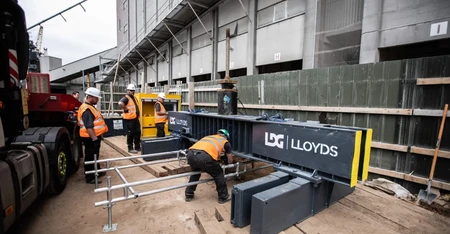

Noise Monitoring for an aggregate processing and bagging facility
Challenge
Breedon’s bagging shed facility in Kinnegad, County Westmeath required occupational noise monitoring to ensure compliance with Irish health and safety legislation – the Safety, Health and Welfare at Work (General Application) Regulations 2007: Part 5 (Control of Noise at Work).
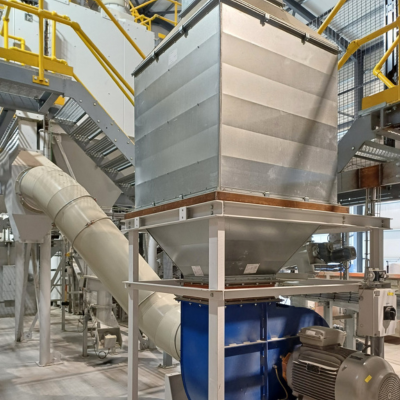
Breedon’s aggregate processing and bagging works at the Kinnegad site potentially placed employees at risk to exposure to high noise levels, due to the mechanical equipment of conveyors and elevators, pneumatic systems for material transfer and bag filling, as well as these multiple noise sources operating simultaneously.
Project Description and Background
Regulations with established exposure action and limit values are in place to protect workers from noise-induced hearing damage. In Ireland, the Safety, Health & Welfare at Work (General Application) Regulations 2007 outline three critical noise exposure thresholds, and specific employer duties are required when personal exposure exceeds these thresholds. This includes risk assessments, health surveillance, employee training, and the provision of necessary personal protective equipment (PPE) such as hearing protection.
Breedon required a noise exposure assessment to quantify employee noise exposure levels across the different roles at their new bagging plant, determine the adequacy of the PPE, and receive recommendations for noise control.

Solution
Solution
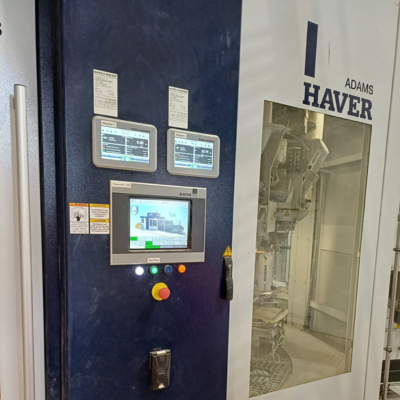
SOCOTEC Ireland completed noise monitoring across the facility. The survey included personal noise dosimetry, peak noise measurements, and activity logging.
Employees across key operational roles wore calibrated noise dosimeters during their shift to capture exposure patterns in relation to the equipment used and type of task being carried out – this included those involved in bagging operations, equipment operators, maintenance personnel, and support staff. This meant the data was representative of the daily exposure levels and normal operational conditions.
A control measures assessment was carried out to evaluate the engineering controls such as equipment enclosures and acoustic treatments, the maintenance regimes for noise-generating equipment, administrative measures to manage work rotation and exposure limitation, and personal hearing protection provision and usage.
Observations were made of the working practices and equipment operating conditions to assess the work patterns and exposure duration with a detailed time-activity analysis. The assessment focused on representative exposure scenarios to provide reliable data for ongoing risk management.
The observations and data
The observations and data captured by SOCOTEC’s Occupational Hygiene Monitoring Technician were supplemented by an employee questionnaire used to document hearing protection usage, work activities, and exposure duration.
The monitoring identified daily noise exposure levels for a range of roles within the facility, with spatial noise mapping to show the higher and lower exposure areas across the site. It provided definitive evidence of whether the noise levels exceeded the Lower Exposure Action Value (80dB(A)) or the Upper Exposure Action Value (85dB(A)), and the adequacy of the hearing protection to reduce exposure below the Exposure Limit Values.
Based on the noise exposure data collected, SOCOTEC provided detailed recommendations following the hierarchy of controls: noise control at the source, engineering controls, administrative controls, and personal hearing protection.
This included using new machinery with low noise emissions and prioritising the equipment maintenance, introducing acoustic enclosures and barriers, providing sufficient training and education regarding noise exposure, and emphasising that hearing protection is the last resort for noise control.
Conclusion
SOCOTEC’s workplace noise monitoring provided Breedon with compliance assurance and risk management through the collected exposure data and documentation, creating an evidence base for control investments. By prioritising recommendations for ongoing noise risk management, Breedon can continue to protect employee health within the bagging facility with informed decisions regarding hearing conservation.
This demonstrates SOCOTEC’s engineering control measure assessment and personal noise dosimetry capabilities in industrial production environments to align with Irish health and safety legislation, ensuring effective worker protection and regulatory compliance.
Want to find out more about Noise Monitoring?
Discover more of our latest News & Media

What lessons could we learn from Section 82 of the Environment Act 2021?




The benefits of Mobile GPR for Ground Radar Imaging Surveys

Three decades later: Nigel Dillon’s journey from Trainee to Managing Director