
Reaching net-zero carbon targets
The Climate Action and Low Carbon Development Act aims to help Ireland achieve a more sustainable environmental and have a climate-neutral economy by 2050, with the development of carbon budgets outlined to achieve this.
Since the Climate Action Plan was established in the Climate Action and Low Carbon Development Act, Ireland has updated the plan five times with statutory annual updates. The most recent update (CAP25) refines the actions needed to deliver the carbon budgets and sets out a roadmap for halving Ireland’s emissions by 2030, aiming for carbon neutrality by 2050.
Reducing carbon emissions is a fundamental aspect of sustainability and takes priority when aiming for net-zero targets – cutting greenhouse gas emissions takes precedent before considering offsetting strategies. For buildings, being net-zero refers to a structure that has zero or negative values of total greenhouse gas emissions across its entire lifecycle.

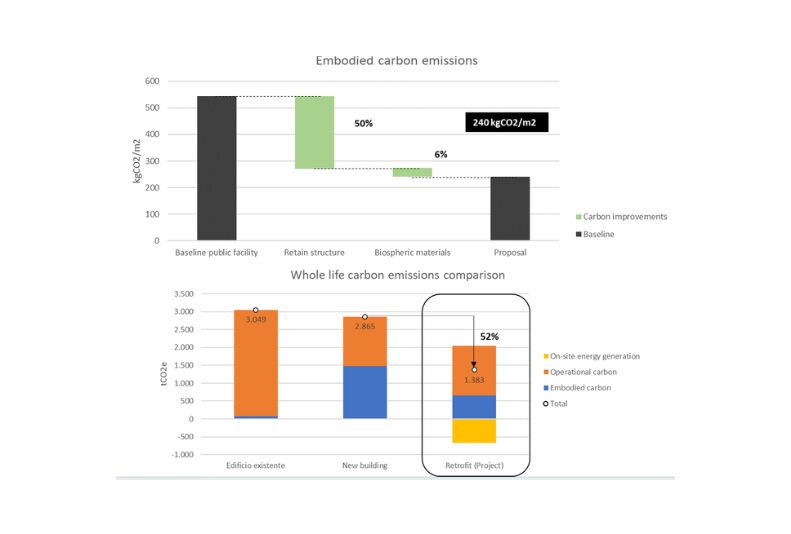
This encompasses two carbon categories: operational carbon and embodied carbon. Operational carbon includes the usage of carbon throughout the building’s lifespan – for example heating, cooling, lighting. Embodied carbon is the usage of carbon before occupancy of the building during the construction stage – for example material extraction, manufacturing, and transportation.
Net-zero targets require permanent carbon emission cuts as well as implementing removal technologies – this is carried out in a more substantial manner than carbon neutral strategies that predominantly just focus on off-setting carbon. The three principles of net zero are transform value chains, support emission reductions, and invest in permanent carbon removal technologies.
This encompasses two carbon categories: operational carbon and embodied carbon. Operational carbon includes the usage of carbon throughout the building’s lifespan – for example heating, cooling, lighting. Embodied carbon is the usage of carbon before occupancy of the building during the construction stage – for example material extraction, manufacturing, and transportation.
Net-zero targets require permanent carbon emission cuts as well as implementing removal technologies – this is carried out in a more substantial manner than carbon neutral strategies that predominantly just focus on off-setting carbon. The three principles of net zero are transform value chains, support emission reductions, and invest in permanent carbon removal technologies.
At SOCOTEC, we incorporate sustainable practices into every stage of a project, balancing environmental responsibility with economic and social benefits. Reducing carbon emissions is a key aspect of this, and it’s important to develop a net zero strategy.
Carbon reduction falls under SOCOTEC’s Green Trust service. This policy represents a selection of testing, inspection, and certification services that are eligible under EU standards or contribute to one or more of the six environmental objectives of the European Taxonomy: mitigation of climate change, adaptation to climate change, sustainable use of water, circular economy, reducing pollution, and protecting biodiversity.
There are multiple assessments and techniques that can be used to establish carbon reduction strategies in alignment with the increasing regulatory pressures in Ireland and the EU to take greater environmental accountability.
To determine the current carbon footprint of a building, a carbon assessment and baseline audit can be carried out. This then allows for a carbon routemap to be created, with clear carbon reduction targets catered to the areas with significant carbon emissions.
Life Cycle Assessments (LCAs) are used to evaluate the overall potential environmental impact of a construction projects, including the total carbon debt throughout the project’s lifecycle. SOCOTEC’s consultancy services can assist clients to find carbon reduction strategies with a cost-benefit analysis, as well as providing a whole-life carbon optimisation integrated assessment to evaluate the embodied and operational carbon.
For more information regarding SOCOTEC’s carbon reduction compliance and consultancy services, please contact us.
Discover our latest News & Media

What lessons could we learn from Section 82 of the Environment Act 2021?
A Day in the Life: Aisling Brophy, Air and Emissions Technician
A Day in the Life: Sandile Mkhwanazi, Occupational Hygienist