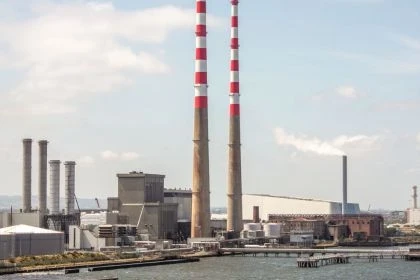

What lessons could we learn from Section 82 of the Environment Act 2021?
In England, Section 82 of the Environment Act 2021 introduced a landmark legal duty for sewerage undertakers to continuously monitor water quality upstream and downstream of storm overflows and sewage treatment works.
Inserted into the Water Industry Act 1991 as new section 141DB, this provision marks a significant shift away from periodic, 'boots on the ground' testing towards real-time, technology-driven transparency.
While Ireland has no equivalent statutory requirement yet, similar obligations could eventually arrive here too.
What does Section 82 require?
Sewerage undertakers operating wholly or mainly in England must continuously monitor water quality both upstream and downstream of qualifying assets, storm overflows and sewage disposal works, where these discharge into a watercourse.
This essentially means monitoring at least every 15 minutes during high-risk periods, and at least hourly otherwise, as well as tracking key indicators such as dissolved oxygen levels to assess the real-world impact of discharges.
Data must be available in as close to real-time as possible, alongside contextual information such as event duration monitoring, a related duty under Section 81.
The impact of Section 82 is still to be felt across England, as a phased rollout is still ongoing, prioritising high-risk sites first, with full coverage across England's 14,000+ storm overflows and 9,000+ sewage disposal works targeted by 2035.

Does Section 82 apply across the UK and Ireland?
It's worth being clear that Section 82 applies only to sewerage undertakers in England — it is not a UK-wide requirement, and the rest of these islands are taking noticeably different approaches to storm overflow monitoring.
Northern Ireland, for instance, has not adopted an equivalent statutory requirement to England's Section 82. When queried on this gap, the Minister for Infrastructure confirmed that the Environment Act 2021 requirements applying in Great Britain do not apply in Northern Ireland, and that NI Water is instead working with regulators on storm overflow reporting requirements. In practice, this means Northern Ireland is now moving to introduce Event Duration Monitoring (EDM) – a monitoring approach that has already been standard practice in England for many years.
In the Republic of Ireland, the regulatory framework looks different again. Continuous water quality monitoring upstream and downstream of every discharge point is not currently required here. That said, oversight isn't absent: discharge authorisations already require operators to identify monitoring and sampling points and to set out monitoring arrangements. This year adds a further layer, with Ireland's Small Wastewater Discharge Register Regulations introducing a requirement for ecological assessment at suitable locations upstream and downstream of certain discharge points, to be carried out every three years.
Taken together, these divergent approaches show that storm overflow oversight is evolving unevenly across the UK and Ireland — and that the Republic of Ireland is not starting from a blank page, even without a direct equivalent to Section 82 in place.
Does Section 82 apply across the UK and Ireland?
It's worth being clear that Section 82 applies only to sewerage undertakers in England — it is not a UK-wide requirement, and the rest of these islands are taking noticeably different approaches to storm overflow monitoring.
Northern Ireland, for instance, has not adopted an equivalent statutory requirement to England's Section 82. When queried on this gap, the Minister for Infrastructure confirmed that the Environment Act 2021 requirements applying in Great Britain do not apply in Northern Ireland, and that NI Water is instead working with regulators on storm overflow reporting requirements. In practice, this means Northern Ireland is now moving to introduce Event Duration Monitoring (EDM) – a monitoring approach that has already been standard practice in England for many years.
In the Republic of Ireland, the regulatory framework looks different again. Continuous water quality monitoring upstream and downstream of every discharge point is not currently required here. That said, oversight isn't absent: discharge authorisations already require operators to identify monitoring and sampling points and to set out monitoring arrangements. This year adds a further layer, with Ireland's Small Wastewater Discharge Register Regulations introducing a requirement for ecological assessment at suitable locations upstream and downstream of certain discharge points, to be carried out every three years.
Taken together, these divergent approaches show that storm overflow oversight is evolving unevenly across the UK and Ireland — and that the Republic of Ireland is not starting from a blank page, even without a direct equivalent to Section 82 in place.
So, what does this mean for the Republic of Ireland?
The Republic of Ireland's environmental and water regulation has consistently mirrored UK developments over time, particularly around drainage, wastewater management, and health and safety compliance.
Given the shared regulatory direction on storm overflow transparency and water quality accountability, it's reasonable to expect Ireland may eventually introduce comparable continuous monitoring duties, whether via amendments to existing water industry legislation or new standalone measures.
For water utilities, developers and asset managers in Ireland, now is a useful moment to take the time to review current monitoring practices around storm overflows, sewage treatment assets, and discharge points into watercourses, as well as understanding how the UK's continuous monitoring requirements are being implemented in practice. This includes sensors, telemetry, and data management systems needed to track parameters like dissolved oxygen in near real-time.
Companies can get ahead by considering proactive flow and water quality monitoring programmes now, and build up a track record of environmental due diligence well ahead of any future statutory requirement.
With direct, hands-on experience supporting UK clients through storm overflow and water quality monitoring, from sensor deployment and telemetry setup to data collection and reporting, SOCOTEC's teams bring practical, cross-market insight to Irish clients preparing for a potentially evolving regulatory landscape. Whether flow monitoring, water quality assessment, or discharge compliance review you are looking for, our teams can help identify risks early and build a clear record of readiness.
As Irish legislation develops in this area, we'll keep you updated with practical guidance tailored to the local market.
Want to find out more about Irish water regulations...
Discover our latest News & Media

What lessons could we learn from Section 82 of the Environment Act 2021?

The benefits of Mobile GPR for Ground Radar Imaging Surveys
Three decades later: Nigel Dillon’s journey from Trainee to Managing Director