

Track Monitoring on Luas Infrastructure, Charlemont Embankment
Challenge
SISK required monitoring and assessments of the Charlemont Embankment, in a live rail environment. SOCOTEC Ireland acted as subcontractor to SISK during works on the Charlemont embankment, monitoring rail alignment, embankment behaviour and adjacent pile wall performance.
Project Description and Background
The Luas light rail tracks are located on the Charlemont Embankment at approximately 6.5m above the ground level of a construction site for development on Grand Parade Dublin. In order for the constructions works to take place safely, a vibration and settlement monitoring system was required to safely keep the rail tracks operational, with a secant pile retaining wall constructed along the embankment with temporary ground anchors to minimise potential impacts to the embankment from the excavation and construction works.

Solution
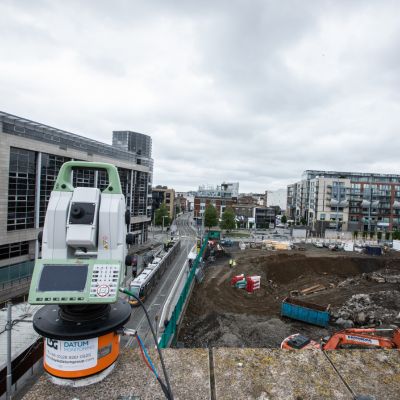
SOCOTEC developed and supplied an integrated monitoring system for the embankment to measure settlements and vibrations during the construction, including monitoring of the track base and the stone retaining wall adjacent to the embankment. The system consisted of real-time vibration and tilt sensors, inclinometer monitoring of the pile wall, and noise and dust monitoring systems. This was accompanied by continuous prism monitoring on the rail web and daily precise levelling to assess track alignment and detect incremental settlement affecting track geometry.
Initially, weekly visits for the project were held to observe the monitoring, but once settlement was detected, the frequency of visits increased to daily and occasionally twice a day for 1.5 years. The operational support scope included continuous monitoring, structured alerting, validated reporting, firmware and software updates, controlled security and performance patches, remote diagnostics, remote configuration and client training.
Alongside the instrumentation installed and commissioned by SOCOTEC, reports compatible with SISK’s project reporting and asset-management workflows were also provided. To support a timely engineering response during the works, notifications and threshold alerts were implemented.
SISK, TII and TDLR were trained on the presentation suite so they could interrogate the data, review trends, and interpret alarms and events without relying solely on manual reporting.
SOCOTEC developed and supplied an integrated monitoring system for the embankment to measure settlements and vibrations during the construction, including monitoring of the track base and the stone retaining wall adjacent to the embankment. The system consisted of real-time vibration and tilt sensors, inclinometer monitoring of the pile wall, and noise and dust monitoring systems. This was accompanied by continuous prism monitoring on the rail web and daily precise levelling to assess track alignment and detect incremental settlement affecting track geometry.
Initially, weekly visits for the project were held to observe the monitoring, but once settlement was detected, the frequency of visits increased to daily and occasionally twice a day for 1.5 years. The operational support scope included continuous monitoring, structured alerting, validated reporting, firmware and software updates, controlled security and performance patches, remote diagnostics, remote configuration and client training.
Alongside the instrumentation installed and commissioned by SOCOTEC, reports compatible with SISK’s project reporting and asset-management workflows were also provided. To support a timely engineering response during the works, notifications and threshold alerts were implemented.
SISK, TII and TDLR were trained on the presentation suite so they could interrogate the data, review trends, and interpret alarms and events without relying solely on manual reporting.
Conclusion
SOCOTEC was able to carry out successful environmental, geotechnical, and structural monitoring. The monitoring configuration was developed to provide integrated visibility of track geometry/alignment, embankment performance, subsurface movement and environmental impacts during the construction works to allow for the rail tracks to remain active during the project.
The contract was delivered over a three-year period with uninterrupted visibility of embankment and track stability, requiring a team of eight SOCOTEC experts to carry out the works, including using personnel for weekends and holidays to maintain continuous monitoring.
The system enabled early detection of movement trends, timely identification of vibration events and clear reporting on noise and dust emissions. By using an integrated reporting approach, decision-making efficiency was improved which reduced the need for repeated site inspections, saving time.
Want to find out more about Track Monitoring?
Discover our latest News & Media

SOCOTEC Ireland joins Interim Remediation Scheme for defective apartments



A Day in the Life: Aisling Brophy, Air and Emissions Technician

SOCOTEC Expands Irish Operations with New Dublin Office Opening

A Day in the Life: Sandile Mkhwanazi, Occupational Hygienist