

Bridge Structural Monitoring
Challenge
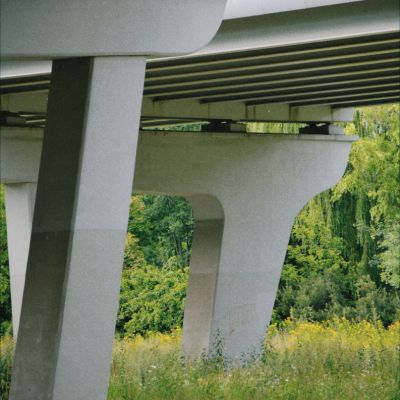
A bridge in Dublin required structural monitoring to assess the behaviour of the reinforced concrete bridge support elements. Over time, the structural supports can become damaged and impacted by environmental factors, resulting in cracks. Monitoring structural integrity is paramount for safety, especially for a critical transport infrastructure like this bridge.
Project Description and Background
There are reinforced concrete river piers, bridge columns, and associated retaining wall elements for structural support of the bridge. These concrete bridge support elements required specialist monitoring, predominantly focusing on crack-affected concrete columns, using instrumentation to provide data on the structural response and ongoing behaviour.
The works formed part of a targeted bridge assessment and monitoring exercise on a critical transport bridge over the river with the monitoring installation undertaken beneath the bridge deck in a live urban river corridor environment.

Solution
SOCOTEC Ireland was approached regarding the project and delivered a specialist structural monitoring installation at the bridge to assess the behaviour of reinforced concrete bridge support elements through dynamic and static strain measurement.
SOCOTEC developed the monitoring system’s configuration in order to meet the project’s requirements, including the selection and arrangement of bonded electrical resistance strain gauge rosettes on multiple bridge columns to capture vertical, horizontal, and 45-degree strain components.
The monitoring design incorporated rosette layouts on four pier river columns, two on the west and two on the east. The arrangement of the rosettes allowed for strain measurements in three principal directions at each point, enabling interpretation of the structural response in cracked and stressed concrete elements.
The supplied monitoring system also included the installation materials, leadwire terminations, protective coatings and connection hardware required for permanent field deployment on the reinforced concrete elements.
The installation works needed access by mobile elevating work platforms (MEWPs) beneath the bridge structure, preparation of the concrete surfaces, bonding of foil strain gauges, leadwire routing, protective coating, logger connection and commissioning checks. Each gauge installation required resistance and insulation checks at gauge and leadwire level using calibrated instrumentation.
As well as recording the strain measurement, the monitoring infrastructure tracked both ambient and concrete temperatures. The system allowed for automatic logging of this information alongside the continuous structural response data from the monitored bridge elements, with GPS synchronisation for the logger. This approach supported improved data interpretation, thermal compensation assessment, and robust time correlation of the recorded events, demonstrating a high-quality structural health monitoring methodology with traceable installation records and long-term data acquisition capability.
SOCOTEC Ireland was approached regarding the project and delivered a specialist structural monitoring installation at the bridge to assess the behaviour of reinforced concrete bridge support elements through dynamic and static strain measurement.
SOCOTEC developed the monitoring system’s configuration in order to meet the project’s requirements, including the selection and arrangement of bonded electrical resistance strain gauge rosettes on multiple bridge columns to capture vertical, horizontal, and 45-degree strain components.
The monitoring design incorporated rosette layouts on four pier river columns, two on the west and two on the east. The arrangement of the rosettes allowed for strain measurements in three principal directions at each point, enabling interpretation of the structural response in cracked and stressed concrete elements.
The supplied monitoring system also included the installation materials, leadwire terminations, protective coatings and connection hardware required for permanent field deployment on the reinforced concrete elements.
The installation works needed access by mobile elevating work platforms (MEWPs) beneath the bridge structure, preparation of the concrete surfaces, bonding of foil strain gauges, leadwire routing, protective coating, logger connection and commissioning checks. Each gauge installation required resistance and insulation checks at gauge and leadwire level using calibrated instrumentation.
As well as recording the strain measurement, the monitoring infrastructure tracked both ambient and concrete temperatures. The system allowed for automatic logging of this information alongside the continuous structural response data from the monitored bridge elements, with GPS synchronisation for the logger. This approach supported improved data interpretation, thermal compensation assessment, and robust time correlation of the recorded events, demonstrating a high-quality structural health monitoring methodology with traceable installation records and long-term data acquisition capability.
Conclusion
This project implemented a targeted method for assessing the behaviour of cracked reinforced concrete bridge elements through direct measurement rather than relying just on visual inspections. The team achieved working safely and effectively while on a constrained bridge infrastructure in a live environment, demonstrating capability in condition assessment, structural monitoring, movement and stress response measurement, and long-term engineering review of bridge substructure elements.
By using multi-axis strain rosettes, automatic logging, and temperature-linked interpretation, the data allowed for an improved understanding of the structural behaviour and supported the engineering decisions regarding the condition and ongoing management of the bridge.
Want to find out more about Bridge Monitoring?
Discover our latest News & Media

SOCOTEC Ireland joins Interim Remediation Scheme for defective apartments



A Day in the Life: Aisling Brophy, Air and Emissions Technician

SOCOTEC Expands Irish Operations with New Dublin Office Opening
A Day in the Life: Sandile Mkhwanazi, Occupational Hygienist